Federated Learning with Patient-Annotated Data in Epileptic Seizure Detection
 Download PDF
 Citation
 Google Scholar
Graphical abstract
Abstract
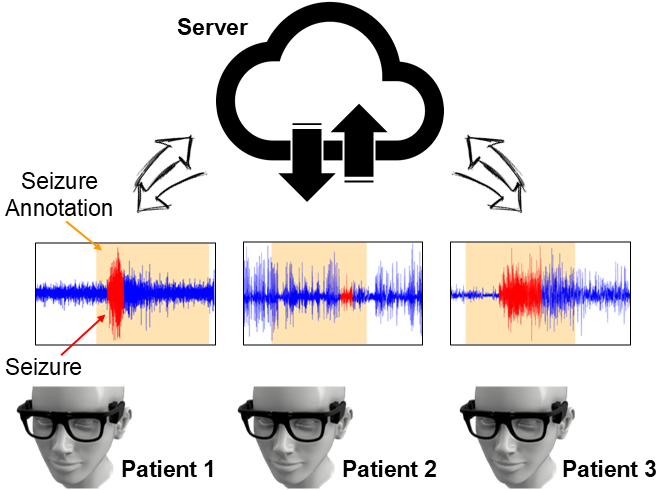
Machine learning (ML) generally requires a substantial amount of data to reach or surpass human-level performance. However, data collection and annotation by experts are known to be costly and time-consuming, which often leads to suboptimal performance for ML algorithms. One approach to tackle this challenge is to adopt patient-annotated data on each patient's device in a federated learning (FL) setting. However, this approach comes with certain challenges. For instance, in the case of epilepsy monitoring, patient-annotated data is known to involve inaccuracies, i.e., patients may lose consciousness and annotate a seizure with substantial delay compared to the seizure onset. To address this challenge, we propose an FL framework for epileptic seizure detection with noisy patient-annotated data. We evaluate our approach in the case of epileptic seizure detection and show that our proposed method achieves up to 32.63% higher accuracy, 32.95% higher specificity, and 22.28% higher F1 score compared to the model trained on the noisy dataset.
BibTeX
@inproceedings{aminifar2025federated,
  author    = {Aminifar, Amin and Dan, Jonathan and Atienza, David},
  title     = {Federated Learning with Patient-Annotated Data in Epileptic Seizure Detection},
  booktitle = {2025 International Joint Conference on Neural Networks (IJCNN)},
  year      = {2025},
  pages     = {1--10},
  }